

This document outlines the key advantages of adopting a custom Enterprise Resource Planning (ERP) system in the business landscape of 2025. It explores how a tailored ERP solution can provide a competitive edge by addressing specific business needs, improving efficiency, enhancing data visibility, and fostering innovation in a rapidly evolving technological environment.
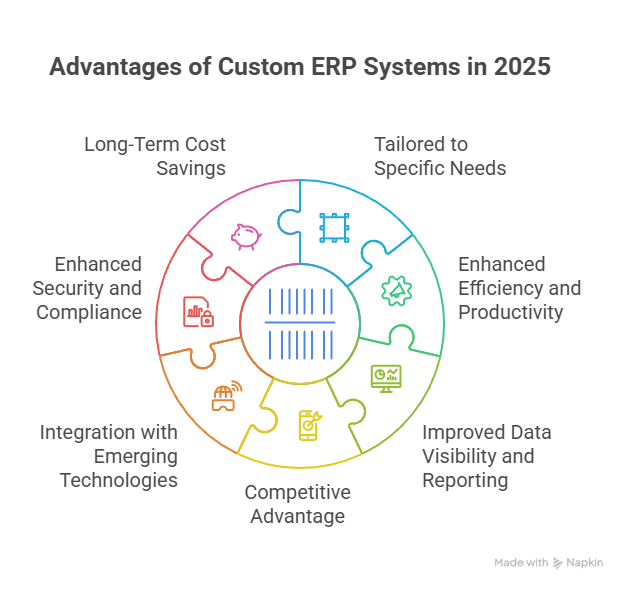
1. Tailored to Specific Business Needs
In 2025, the "one-size-fits-all" approach to ERP systems will be even less effective than it is today. Businesses will operate in increasingly niche markets with unique processes and requirements. A custom ERP system allows for precise alignment with these specific needs, ensuring that the software directly supports and optimizes core business functions.
- Process Optimization: Custom ERPs can be designed to mirror existing workflows, eliminating the need to adapt business processes to fit the software. This reduces disruption and accelerates adoption.
- Niche Functionality: Standard ERPs often lack features specific to certain industries or business models. A custom solution can incorporate these niche functionalities, providing a competitive advantage.
- Scalability and Flexibility: As businesses grow and evolve, their needs change. A custom ERP can be built with scalability in mind, allowing for easy adaptation and expansion as required.
2. Enhanced Efficiency and Productivity
By streamlining operations and automating repetitive tasks, a custom ERP system can significantly improve efficiency and productivity. This is particularly crucial in 2025, where businesses will face increasing pressure to do more with less.
- Automation of Tasks: Custom ERPs can automate tasks such as data entry, report generation, and inventory management, freeing up employees to focus on more strategic activities.
- Improved Workflow Management: By centralizing data and providing real-time visibility into operations, a custom ERP can streamline workflows and reduce bottlenecks.
- Reduced Errors: Automation and data validation features can minimize errors, leading to improved accuracy and reduced costs associated with correcting mistakes.
3. Improved Data Visibility and Reporting
Data will be the lifeblood of businesses in 2025. A custom ERP system can provide enhanced data visibility and reporting capabilities, enabling better decision-making and strategic planning.
- Centralized Data Repository: A custom ERP consolidates data from various departments and functions into a single, centralized repository, providing a holistic view of the business.
- Real-Time Insights: Real-time data access allows for immediate insights into key performance indicators (KPIs), enabling proactive decision-making.
- Customized Reporting: Custom ERPs can generate reports tailored to specific needs, providing valuable insights into areas such as sales, marketing, finance, and operations.
4. Competitive Advantage
In the increasingly competitive landscape of 2025, a custom ERP system can provide a significant competitive advantage by enabling businesses to operate more efficiently, make better decisions, and respond quickly to changing market conditions.
- Faster Time to Market: Streamlined processes and improved data visibility can accelerate product development and launch cycles, allowing businesses to get to market faster.
- Improved Customer Service: A custom ERP can integrate with CRM systems to provide a 360-degree view of customers, enabling personalized service and improved customer satisfaction.
- Innovation and Agility: By providing a flexible and adaptable platform, a custom ERP can foster innovation and enable businesses to respond quickly to new opportunities and challenges.
5. Integration with Emerging Technologies
2025 will see the widespread adoption of emerging technologies such as artificial intelligence (AI), machine learning (ML), and the Internet of Things (IoT). A custom ERP system can be designed to seamlessly integrate with these technologies, unlocking new possibilities for automation, optimization, and innovation.
- AI-Powered Automation: AI can be integrated into a custom ERP to automate tasks such as predictive maintenance, demand forecasting, and fraud detection.
- ML-Driven Insights: ML algorithms can analyze data from the ERP to identify patterns and trends, providing valuable insights for decision-making.
- IoT Connectivity: Integrating with IoT devices can provide real-time data on equipment performance, inventory levels, and other critical metrics, enabling proactive management and optimization.
6. Enhanced Security and Compliance
Data security and regulatory compliance will be paramount in 2025. A custom ERP system can be designed with robust security features and compliance controls to protect sensitive data and ensure adherence to industry regulations.
- Custom Security Protocols: Tailored security protocols can be implemented to protect against specific threats and vulnerabilities.
- Data Encryption: Data encryption can be used to protect sensitive data both in transit and at rest.
- Compliance Management: Custom ERPs can be designed to comply with industry-specific regulations, such as HIPAA, GDPR, and CCPA.
7. Long-Term Cost Savings
While the initial investment in a custom ERP system may be higher than that of a standard solution, the long-term cost savings can be significant. By improving efficiency, reducing errors, and enabling better decision-making, a custom ERP can deliver a strong return on investment.
- Reduced Operational Costs: Automation and streamlined processes can reduce operational costs, such as labor, materials, and energy.
- Improved Inventory Management: Optimized inventory management can reduce carrying costs and minimize waste.
- Better Resource Allocation: Improved data visibility can enable better resource allocation, ensuring that resources are used effectively and efficiently.
In conclusion, implementing a custom ERP system in 2025 offers a multitude of benefits, including tailored functionality, enhanced efficiency, improved data visibility, a competitive advantage, integration with emerging technologies, enhanced security, and long-term cost savings. By carefully considering their specific needs and investing in a custom solution, businesses can position themselves for success in the rapidly evolving business landscape of the future.